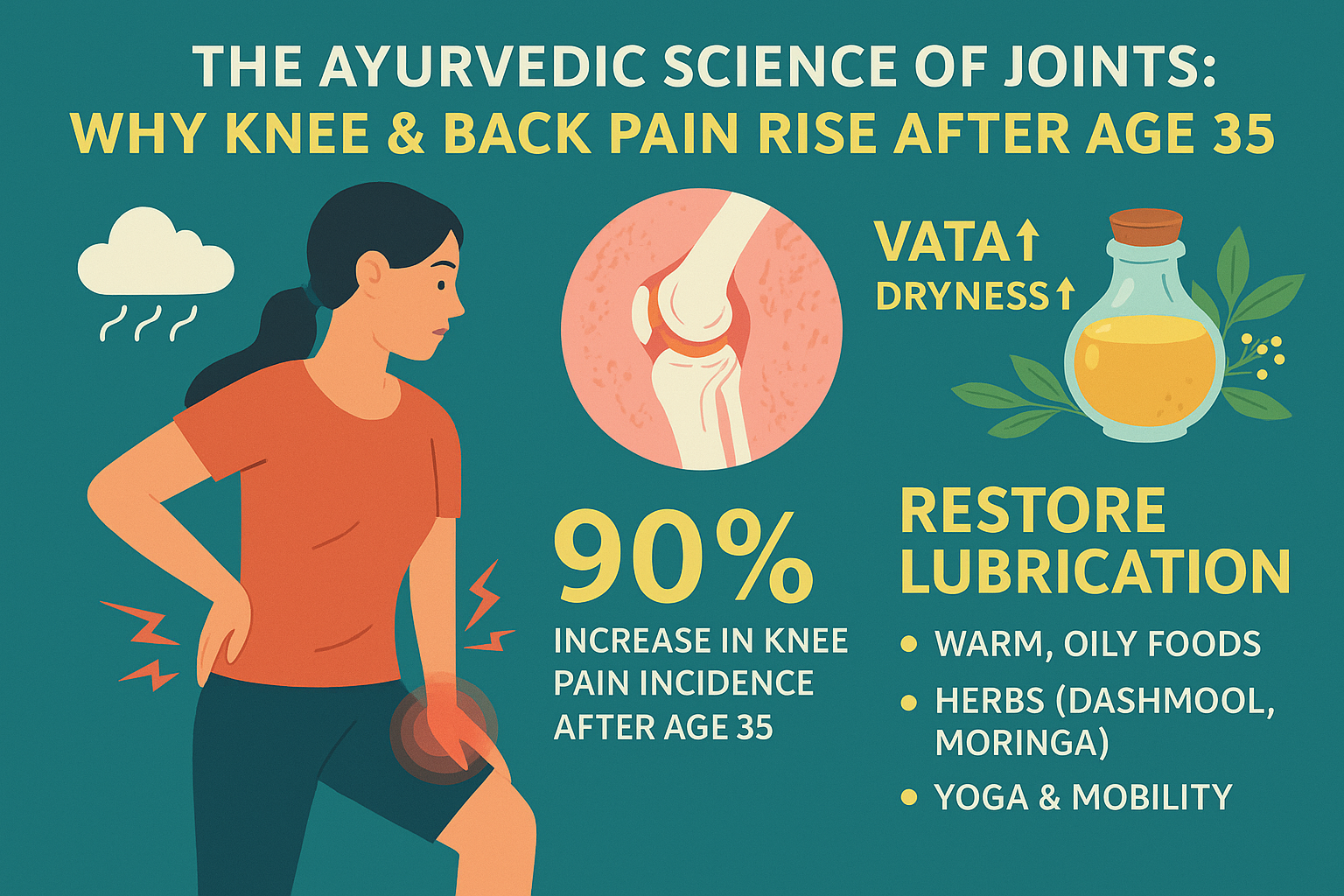
Knee pain, back stiffness, cracking joints, and reduced mobility often begin after age 35. Ayurveda explains this as Vata aggravation, while modern science links it to collagen loss, synovial fluid decline, and bone mineral reduction. This blog integrates Ayurveda, Yoga, and scientific wisdom to help you understand why joints age — and what you can do to keep them supple, strong, and pain-free.
- Why Joint Pain Begins After 35 — Ayurveda & Science Agree
Ayurveda describes life in three phases:
- Kapha phase → childhood (lubrication, growth)
- Pitta phase → adulthood (energy, metabolism)
- Vata phase → after 35–40 (dryness, degeneration)
Ashtanga Hridayam (Sūtra 1.6):
“वयोवृद्धे वायोः प्रकोपः।”
Vayovṛddhe vāyoḥ prakopaḥ
Meaning:
As age increases, Vata naturally rises.
Vata = dryness + cold + roughness
→ directly affects joints, which require oiliness and cushioning.
Modern science says the same:
- Collagen decreases 1% per year after age 30
- Synovial fluid (joint lubricant) becomes thinner
- Cartilage wear begins
- Vitamin D absorption reduces
- Bone mineral density declines (especially in women post-40)
This combination → stiffness, cracking sound, joint pain, and reduced flexibility.
- Why Joint Pain Worsens in Winter
Winter is the season of Vata aggravation:
- Dry cold air → dries synovial fluid
- Reduced sunlight → low Vitamin D
- Less movement → muscles stiffen
- Cold causes tightening of fascia & ligaments
Ayurveda describes winter as Shishir Ritu, dominated by Vata’s cold, dry, rough qualities.
This is why:
Morning stiffness increases
Knees crack more
Lower back tightens
Existing pain becomes worse
Movement + warmth + lubrication becomes essential.
- Why Morning Stiffness Happens
Morning is Vata time of day (2 am–6 am).
Joint fluid is cooler and thickest at this time.
Less nighttime movement → synovial fluid settles.
So when you wake:
- Joints feel tight
- Back feels stiff
- Knees feel heavy
Ayurveda advises gentle snehan (oiling) + svedan (warmth) + slow movement in the mornings.
- Osteoarthritis vs Vata Joint Disorder — Know the Difference
Osteoarthritis (Medical)
- Cartilage breakdown
- Bone spurs
- Swelling, heat in joint
- Seen on X-ray
Vata Joint Disorder (Ayurveda)
- Pain increases with cold
- Stiffness, cracking sound
- Dryness in joints
- Weak digestion causing poor tissue-nutrition
- Often normal scans, but pain persists
Most corporate professionals experience Vata-type functional pain — not structural changes.
- Foods That Lubricate, Warm & Nourish Joints
Ayurveda calls joints “Sandhi” — points requiring oiliness & strength.
Top foods:
Ghee — best natural joint lubricant
Sesame oil — warm, Vata-pacifying
Methi (fenugreek) — anti-inflammatory
Moringa leaves — high in calcium, magnesium, iron
Curry leaves — bone-strengthening, rich in minerals
Turmeric + black pepper — reduces inflammation
Ashwagandha — strengthens bones & muscles
Dashmool — reduces Vata, great for pain
Til (sesame seeds) — calcium-rich
Bone broth / soups — collagen support
Sunlight exposure — Vitamin D synthesis
Vitamin D Sources:
- Sunlight (best)
- Mushrooms
- Fortified milk
- Ghee
- Eggs
Calcium Sources:
- Sesame seeds
- Moringa
- Curry leaves
- Ragi
- Almonds
- Amla
- Milk (if tolerated)
Avoid foods that dry joints:
Excess coffee/tea
Too much cold water
Dry snacks (namkeen, bhujia, popcorn)
Frequent fasting without oil
Extremely spicy/fermented foods
- Herbs & Ayurveda Remedies for Joint Strength
- Moringa (Drumstick leaves)
Anti-inflammatory, high calcium, rejuvenates joints.
- Curry Leaves
Rich in calcium + antioxidants → strengthens bones.
- Dashmool
Used for Vata disorders & deep pain.
- Ashwagandha
Strengthens muscles, reduces stress-induced inflammation.
- Guggulu formulations
Like Yograj Guggulu, Trayodashang Guggulu — for chronic pain.
- Nirgundi (Vitex negundo)
Used as oil for reducing swelling.
- Mahanarayan Oil Massage
Warms joints, increases lubrication, reduces stiffness.
- Yoga Restores Lubrication — The Science of Movement
Yoga restores joint lubrication through synovial fluid activation.
Movement = lubrication.
Stillness = stiffness.
Hatha Yoga Pradipika (1.17):
“शरीरस्य स्थैर्यं च लघुत्वं च उत्पद्यते।”
Śarīrasya sthairyaṃ ca laghutvaṃ ca utpadyate
Meaning: Yoga creates stability and lightness in the body.
Best Yoga Asanas for Joint Health
Knees:
- Vajrasana (if no pain)
- Setu Bandhasana (Bridge)
- Utkatasana (Chair Pose)
- Virabhadrasana 1 & 2
- Trikonasana
Hips & Lower Back:
- Pawanmuktasana
- Marjaryasana–Bitilasana (Cat–Cow)
- Anjaneyasana
- Baddha Konasana
- Shalabhasana
Ankles & Feet:
- Toe raises
- Ankle rotations
- Vajrasana ankle stretch
Shoulders & Wrists:
- Gomukhasana arms
- Wrist rotations
- Garudasana arms
Daily 7-minute routine:
- Cat–Cow (1 min)
- Hip circles (1 min)
- Ankle–knee rotations (2 min)
- Gentle backbend (1 min)
- Twist (1 min)
- Deep breathing (1 min)
- Simple Office Joint Routine (Chair Yoga)
Perfect for corporate professionals.
Every 60–90 minutes:
- Wrist rolls
- Shoulder shrugs
- Seated spinal twist
- Ankle pumps
- Knee lifts
- Seated forward bend
- “Engine Daud” (marching at desk)
Movement prevents Vata accumulation and keeps joints warm.
- Why Bones Become Brittle With Age
Ayurveda explains bone health through Asthi Dhatu.
When digestion weakens, Asthi gets less nutrition, causing:
- Weak bones
- Pain
- Hair fall (Asthi & Kesh share same root)
- Brittle nails
- Dental issues
Modern reasons:
- Low Vitamin D
- Low calcium
- Lack of sun
- Sedentary lifestyle
- Dehydration
- Hormonal decline (menopause)
- Poor diet
- Chronic stress (high cortisol = bone loss)
Hip fractures:
Most common fracture after age 65.
Not due to the fall — the bone breaks first, causing the fall.
Movement + nourishment + sunlight = prevention.
- Winter Joint Protection Protocol (Daily)
Morning:
- Sesame oil massage on knees & lower back
- Warm shower
- 10 minutes of joint mobilization
- Avoid cold food/water
Day:
- Warm meals + ghee
- Herbal tea (ginger, cinnamon, dashmool)
- Sunlight exposure
Night:
- Turmeric milk with ghee
- Gentle stretching
- Keep legs warm
- What to Avoid (Critical)
Sitting for long hours
Cold water & cold foods
Sleeping late (Vata worsens)
Running on hard surfaces
Wrong yoga (oversplits, excessive stretching)
High heels
Smoking (reduces bone density)
Stress — tightens fascia
- The Takeaway
Your joints are living tissue — they respond to how you live.
When you combine:
Warm, lubricating food
Vitamin D & calcium
Herbs (moringa, curry leaves, dashmool)
Daily yoga & mobility
Pranayama & stress reduction
Oil massage & heat therapy
Winter-specific care
Your joints become:
Flexible
Pain-free
Strong
Lubricated
Youthful
Movement is medicine. Lubrication is Ayurveda. Breath is the bridge.
As the ancient texts say:
“वायोः कुपिते सर्वं कुपितम्।”
When Vata is disturbed, everything becomes disturbed.
Care for your joints, and they will carry you gracefully for decades to come.