
Most people chase fitness through sweating, long workouts, diets, and extreme routines — but ignore the most fundamental pillar of health: breathing. Science shows 90% of fat leaves the body through the lungs, not sweat. Yoga teaches that incorrect breathing restricts prāṇa and leads to disease. This blog explains why breathing is your real life-force, how most people breathe incorrectly, how to test your breathing capacity, and how to retrain yourself using ancient Yogic techniques backed by modern physiology.
- The Most Ignored Truth About Health
When people want to lose weight or “get healthy,” they usually:
- Join a gym
- Run on a treadmill
- Focus on sweating
- Push harder
- Hold their breath during exercise
- Ignore their breathing completely
But here is what science says:
When fat is metabolised, 90% of it leaves through your breath as carbon dioxide (CO₂). Only about 10% becomes water (urine, sweat, tears).
This means:
We lose weight primarily through breathing — not sweating.
And yet breathing is the thing most people do wrong.
- What Ayurveda & Yoga Say About Breath
Thousands of years ago, ancient texts already recognised breath as the foundation of health.
Hatha Yoga Pradipika (2.2):
“चले वाते चलं चित्तं, निश्चले निश्चलं भवेत्।”
Chale vāte chalaṃ cittaṃ, niścale niścalaṃ bhavet.
Meaning: When the breath is unsteady, the mind is unsteady. When the breath becomes steady, the mind becomes steady.
Yoga Sutra (2.52):
“ततः क्षीयते प्रकाशावरणम्।”
Tataḥ kṣīyate prakāśāvaraṇam
Meaning: Through pranayama, the veil blocking inner clarity is removed.
Ayurvedic Principle:
Where oxygen is low → disease develops.
Where prāṇa is low → suffering develops.
Modern science agrees.
Shallow breathing reduces oxygen supply, disturbs CO₂ balance, increases acidity in the body, raises cortisol, increases heart rate, disrupts sleep, and makes fat-burning inefficient.
- Why Most People Breathe Incorrectly
In modern life, most people breathe:
- Too fast
- Too shallow
- Using chest instead of diaphragm
- With tension
- With poor exhale control
- While holding their stomach in
But the deeper reason is psychological:
We inhale as if trying to “take more,” and we exhale quickly as if we “don’t have time.”
This emotional pattern literally becomes our breath.
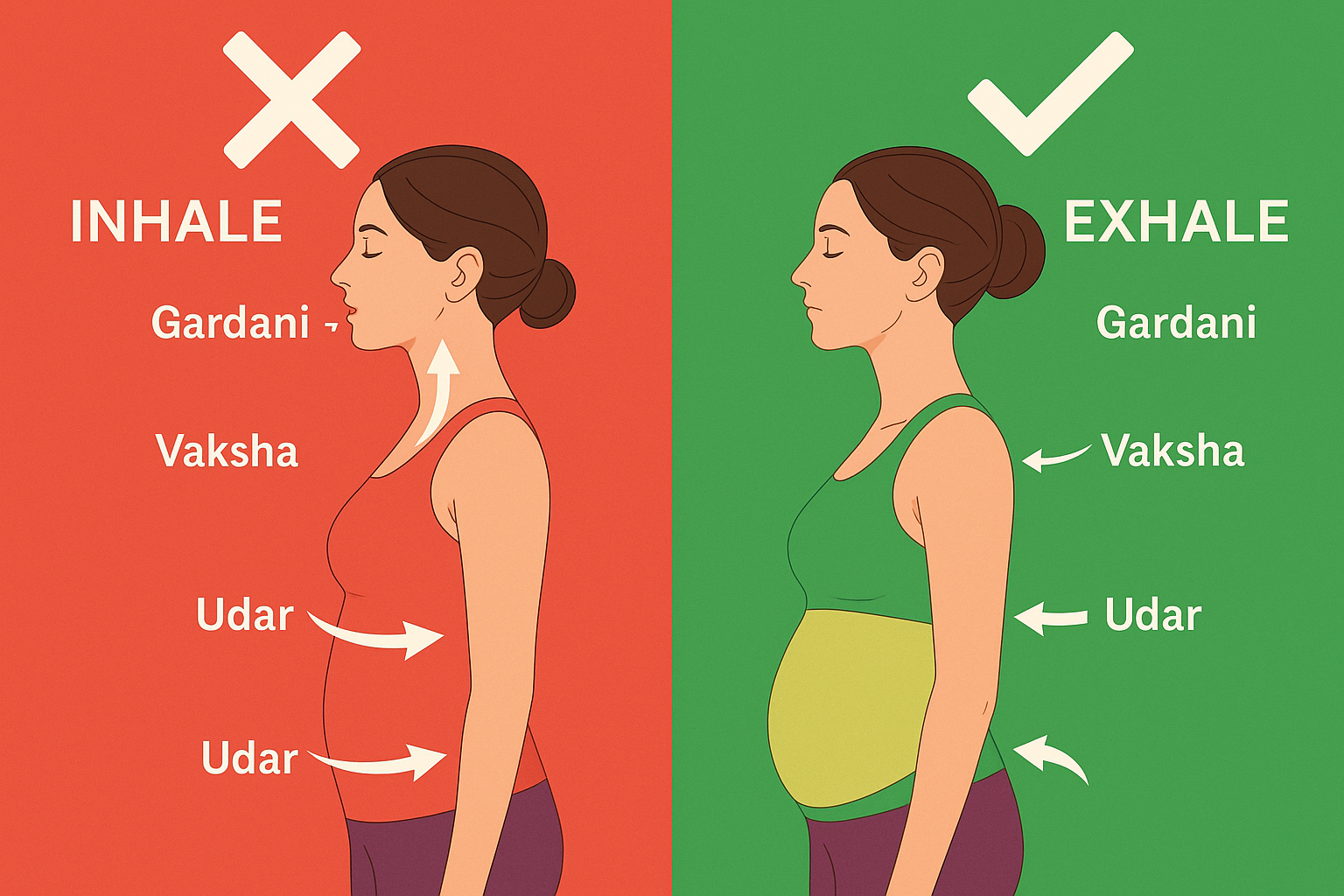
The incorrect pattern most people follow:
- Inhale: chest expands, stomach sucks in
- Exhale: stomach expands, chest collapses
This restricts the diaphragm, reduces lung capacity, and creates shallow breathing, the root of many stress disorders.
- The Biggest Myth: “Stomach Breathing is Wrong”
People think:
“The stomach is for eating. How can we breathe into it?”
You are NOT breathing into the stomach.
You are using the stomach muscles to move the diaphragm, which creates MORE space for the lungs to fill downward.
This is the essence of Yogic breathing.
- The Yogic Three-Part Breath (Yogic Śvāsa)
This is the most complete, natural way to breathe.
Step 1: Udar Śvāsan (Abdominal / Diaphragmatic Breath)
As you inhale,
- Diaphragm pulls down
- Belly gently expands
- Lower lungs fill first
This is the most important step.
Step 2: Vakṣa Śvāsan (Chest Breathing)
After the belly expands
- Ribs stretch sideways
- Middle lungs fill
Step 3: Gardani Śvāsan (Clavicular / Upper-Lung Breathing)
Finally
- Upper chest expands
- Air fills top lobes near collarbones
Exhaling is the reverse:
- Upper lungs empty
- Chest empties
- Belly gently pulls in at the end
This is how the body is designed to breathe — but most people breathe the opposite way!
- A Simple Breathing Test — Check Your Lung & Heart Health
Safety note: Avoid if you’re pregnant, have heart/lung disease, or dizziness issues.
- Inspiratory Breath-Hold Test (After Full Inhale)
- Inhale normally → inhale fully → hold
- Time until you feel the first strong urge to breathe
General interpretation:
- Below 20 sec → poor breathing capacity
- 20–40 sec → average
- 40–60 sec → good
- 60+ sec → excellent
(These values correlate with cardiopulmonary reserve.)
- Expiratory Breath-Hold Test (After Full Exhale)
- Exhale fully → hold
- Time until discomfort
Interpretation:
- Lower times = low CO₂ tolerance
- Higher times = better breathing efficiency & calm nervous system
- Why Correct Breathing = Longer Life
In Indian culture, we say:
“He is taking his last breath.”
We don’t say “last heartbeat” or “last thought.”
We measure life in breaths.
If something can be counted, it must be used wisely.
This is the foundation of pranayama:
Slow breath = long life
Fast breath = short life
Animals with slow breathing (tortoise, elephant) live long.
Animals with rapid breathing (dog, rat) live short.
- Why We Breathe Incorrectly
Because we live in hurry.
We try to do everything fast — walk fast, eat fast, talk fast, think fast…
So we also breathe fast.
Chest breathing is the body’s emergency mode (fight-or-flight).
But most people live in this mode 24/7.
- How to Fix Your Breathing (Step-by-Step)
Here is a simple way to re-train yourself.
Step 1 — Master Diaphragmatic Breathing (Udar)
- Sit or lie down
- Overlap both palms on your stomach
- Inhale → let stomach expand naturally
- Exhale → use your palms to gently push the stomach in
Repeat for 2–5 minutes.
Practice only this for a few weeks until it becomes natural.
Step 2 — Add Chest Breathing (Vakṣa)
Once stomach breathing feels easy, add:
- Belly expands first
- THEN ribs expand
Practice for 2–4 weeks.
Step 3 — Add Upper Lung Breathing (Gardani)
After belly + chest
- Slightly lift upper chest
- Keep shoulders soft
Practice gently.
Step 4 — Reverse on Exhale
To exhale:
- Release upper chest
- Release chest
- Finally pull belly in
Mastery takes months — but the transformation is powerful.
- Why Pranayama Fails for Many People
People say:
“I’ve done pranayama for years — no transformation.”
Why?
Because they practice pranayama on top of incorrect breathing:
- No diaphragm
- Chest dominant
- Short exhale
- No control over breath pathway
Correct pranayama requires:
Deep, slow inhale
Longer exhale
Smooth control of lung space
Relaxed, expansive diaphragm
Without this foundation, results stay superficial.
- The Scientific Benefits of Correct Breathing
Modern studies show:
- Slow breathing reduces cortisol
- Deep exhalation stimulates the vagus nerve
- Correct breathing improves HRV, immunity & digestion
- Diaphragmatic breathing improves core strength and oxygenation
- Longer exhales improve emotional stability & cognitive performance
- Slow breathing increases fat oxidation efficiency
- And yes — most fat leaves the body as CO₂
Your breath touches every system in the body.
- A 2-Minute Daily Breath Routine
You can do this anytime during the day:
Cycle (30 seconds each):
- Udar breathing (belly expands first)
- Udar + Vakṣa (belly + ribs)
- Full yogic breathing
- Slow exhale twice as long as inhale
You will feel calmer, clearer, and more grounded instantly.
- The Takeaway
Breath is the fuel of life.
It is the first thing we do when born and the last thing we do before leaving.
And yet, we spend our entire life breathing incorrectly.
Correct breathing:
Improves lifespan
Reduces stress
Improves fat metabolism
Enhances mental clarity
Strengthens immunity
Boosts energy
Deepens meditation
Improves sleep
And it starts by mastering something incredibly simple:
One breath.
Done correctly.
Repeated daily.
As Patañjali says:
“ततः क्षीयते प्रकाशावरणम्।”
Pranayama removes the veil covering the inner light.
Your breath is your medicine.
Your breath is your power.