
When asked why health is important, most people will say it allows us to “live longer” or “work better.” But Ayurveda, Yoga, and modern science remind us that health is much more than the absence of disease. It is the very foundation of a meaningful life.
Health as the Foundation of Life
Caraka Saṃhitā, one of Ayurveda’s classical texts, opens with a timeless truth:
धर्मार्थकाममोक्षाणामारोग्यं मूलमुत्तमम्।
आरोग्यं परमं भाग्यं स्वास्थ्यं सर्वार्थसाधनम्॥
“Good health is the supreme foundation of Dharma (righteousness), Artha (wealth), Kāma (desire), and Mokṣa (liberation). Disease destroys not only health but also prosperity, longevity, and the very ability to pursue life’s four goals.”
Simply put: Without health, everything else—career, relationships, even spiritual growth—suffers.
What is Health?
The World Health Organization defines health as “a state of complete physical, mental, and social well-being, and not merely the absence of disease or infirmity.” Many scholars suggest “spiritual well-being” should also be included.
Ayurveda, however, provided a holistic definition thousands of years ago that still resonates today.
Who is Healthy? The Ayurvedic View
According to Suśruta Saṃhitā:
समदोषः समाग्निश्च समधातुमलक्रियः।
प्रसन्नात्मेन्द्रियमनः स्वस्थ इत्यभिधीयते॥
A person is truly healthy when:
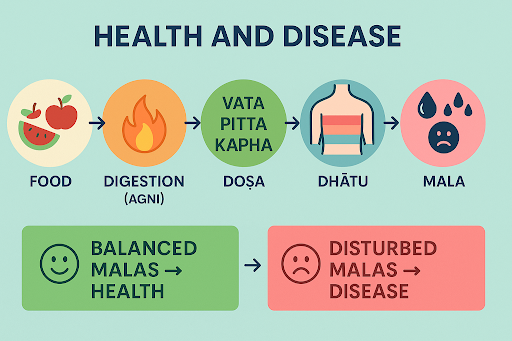
- Doshas (Vata, Pitta, Kapha) are in balance
- Agni (digestive and metabolic fire) functions properly
- Dhatus (tissues: plasma, blood, muscle, fat, bone, marrow, reproductive fluid) are in equilibrium
- Malas (waste products: urine, stool, sweat) are eliminated properly
- Mind, senses, and spirit are joyful and content
This definition is striking because it unites body, mind, and spirit—something even modern medicine is still learning to integrate.
Where Do Diseases Begin?
Ayurveda gives us a profound axiom:
सर्वे रोगाः मलाश्रयाः।
Sarve rogāḥ malāśrayāḥ
“All diseases are rooted in the improper state of body wastes.”
Caraka explains: when stool, urine, or sweat are retained, blocked, or eliminated improperly, they disturb the doshas, setting the stage for disease. Suśruta adds that both excess and deficiency of malas cause imbalance.
Thus: Balanced malas = health. Disturbed malas = disease.
Connecting Health and Yoga
Yoga and Ayurveda are sister sciences. Where Ayurveda defines what health is, Yoga provides the practical tools to maintain it:
- Asana (Postures): Keep doshas balanced, support tissues, and aid elimination.
- Pranayama (Breathwork): Improves agni, calms the mind, and enhances energy flow.
- Meditation: Restores the mind and senses to a state of contentment.
- Lifestyle (Yama & Niyama): Acts of kindness, discipline, and balance create inner harmony.
Together, they teach us that health is not a future goal—it is a daily practice of balance.
The Takeaway
- Health is not optional—it’s the root of all success in life.
- According to Ayurveda, a healthy person is one whose doshas, digestion, tissues, and wastes are in balance—while mind and spirit remain joyful.
- Disease begins when waste products (malas) are disturbed.
- Yoga offers practical methods to maintain this balance every day.
To live fully, work productively, and grow spiritually, we must remember: Health is the greatest wealth.