
In 2025, we have smart homes, smart watches, smart toilets —
but very stiff hips, weak knees, tight backs, and poor digestion.
We avoid:
- stairs (there’s always a lift)
- squatting (chairs are easier)
- sitting on the floor (bad for clothes, apparently)
- Indian toilets (too “difficult”)
- Vajrasana after meals (“who has time?”)
And then we wonder why:
- knees hurt early
- hips feel jammed
- digestion is slow
- posture collapses
- getting up from the floor feels like an Olympic event
This is not ageing.
This is environment-induced weakness.
Anthropology Speaks: Humans Were Never Chair-Based Creatures
For over 200,000 years, humans:
- sat on the ground
- squatted to eat, cook, work, and relieve themselves
- used hips and ankles fully every day
Chairs are a very recent invention — barely a few hundred years old.
Our bodies never adapted to them.
Anthropologists note:
Traditional societies that still sit on the floor and squat daily have:
- fewer knee replacements
- better hip mobility
- stronger spines
- easier childbirth
- better digestion
The body doesn’t lose ability with age —
it loses ability with non-use.
Ayurveda: Movement Is Lubrication
Ayurveda doesn’t separate posture, digestion, and joints.
They are one system.
Classical wisdom
“शरीरं व्याधि-मन्दिरम्।”
The body becomes a house of disease when natural functions are neglected.
When we stop:
- squatting → hips lose range
- floor sitting → spine stiffens
- Vajrasana → digestion weakens
Vata (dryness, degeneration) rises silently.
The Chair Problem Nobody Talks About
Chairs lock the body at 90 degrees:
- hips stop opening
- ankles stop bending
- knees stop loading naturally
- spine forgets how to self-support
Biomechanically, this causes:
- weak glutes
- tight hip flexors
- compressed lumbar spine
- overloaded knees
So yes — the chair is comfortable,
but comfort is not the same as health.
Why Squatting (Malasana / Kagasana) Is Non-Negotiable
The yogic squat (Malasana / Kagasana) is not an “exercise”.
It is a human resting position.
Benefits:
- decompresses the spine
- strengthens knees safely
- improves ankle mobility
- stimulates digestion
- activates pelvic floor
- supports bowel movement
Modern science agrees:
Squatting increases intra-abdominal pressure in a healthy way, aiding elimination and gut motility.
A Simple but Powerful Morning Ritual (Lifestyle Gold)
Start your day like this:
- Drink 2–3 glasses of warm water
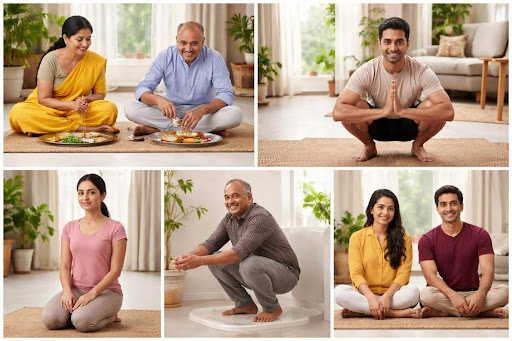
- Sit in Kagasana (yogic squat) for a few minutes
That’s it.
This:
- stimulates colon reflex
- improves bowel movement
- wakes up hips, ankles, knees
- reduces constipation
- gently energises the nervous system
No supplements.
No gadgets.
No apps.
Just intelligence.
Eating on the Floor: Digestion’s Forgotten Ally
In traditional Indian homes:
- food was eaten on the floor
- sitting in Sukhasana
- plates placed low
Why this worked:
- spine stays upright
- abdomen remains relaxed
- breathing deepens naturally
- overeating reduces
- digestion improves
Ayurveda says digestion begins before the first bite — with posture.
Vajrasana After Meals: The Most Ignored Miracle
Vajrasana is the only posture Ayurveda allows after eating.
Why?
- directs blood flow to digestive organs
- improves Agni
- reduces gas and acidity
- prevents heaviness
- improves nutrient absorption
Ayurvedic principle
“वज्रासनं जठराग्नि दीपयति।”
Vajrasana kindles digestive fire.
Just 5–10 minutes after meals can:
- reduce bloating
- improve metabolism
- protect knees (when done gently)
Indian Toilets vs Western Toilets (Biomechanics, Not Culture)
Indian-style toilets force you to:
- squat fully
- align hips, knees, ankles
- use pelvic floor naturally
Western toilets:
- keep hips half-bent
- strain colon
- weaken pelvic muscles
Modern research shows:
Squatting straightens the anorectal angle → easier, strain-free elimination.
Digestive problems didn’t increase because food changed alone —
posture changed too.
Why Kids Have Better Knees Than Adults
Children:
- sit on the floor
- squat effortlessly
- get up without thinking
- move playfully
Adults:
- calculate before sitting
- look for armrests
- fear getting stuck
Yoga says:
Movement should feel playful, not mechanical.
When posture becomes serious, stiffness follows.
Small Changes That Reverse Big Damage
You don’t need to abandon chairs completely.
Just reintroduce lost positions:
- Squat for 1–2 minutes daily
- Sit on the floor while eating once a day
- Use Vajrasana after meals
- Choose stairs for 1–2 floors
- Stretch hips before sleeping
Health returns quietly, not dramatically.
The Deeper Yogic Truth
Yoga was never about poses.
It was about how you live between poses.
Hatha Yoga wisdom
“शरीरस्य स्थैर्यं च लघुत्वं च उत्पद्यते।”
Yoga brings stability and lightness to the body.
Floor sitting restores:
- stability (strong joints)
- lightness (free movement)
The Takeaway
In 2025, sitting on the floor is not outdated —
it is rebellious intelligence.
When you:
- squat daily
- sit cross-legged
- eat mindfully on the floor
- use Vajrasana
- move like a human again
Your body remembers what it already knows.
Chairs may be modern.
But the floor still knows how to heal you.