
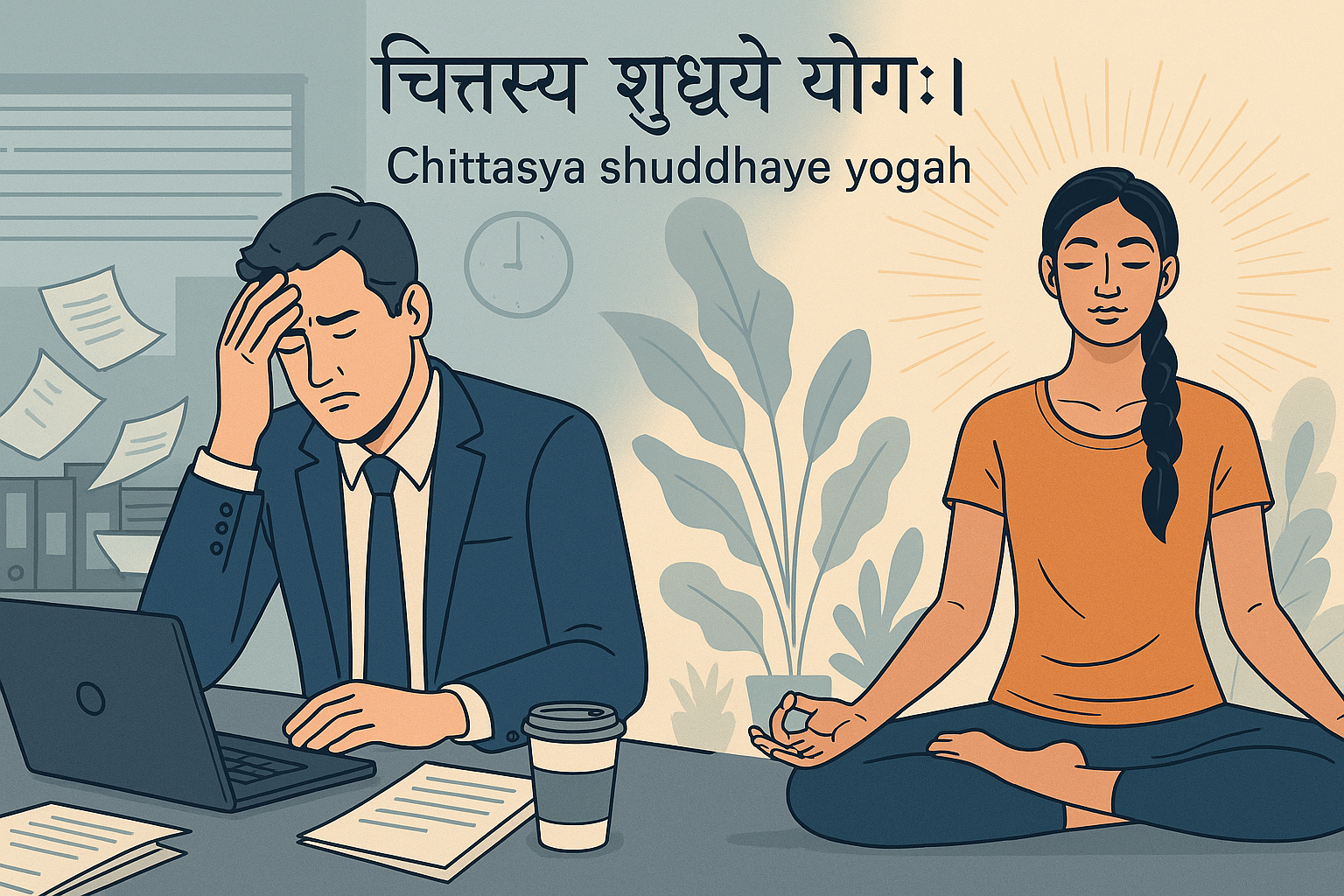
World Mental Health Day (October 10) is a reminder that mental wellness is not optional — especially in India’s high-pressure corporate culture. This blog explains how simple yoga, pranayama, and mindfulness practices can reduce stress, prevent burnout, and improve focus. Rooted in ancient wisdom from the Yoga Sutras and Ayurveda, and supported by modern research.
Why Mental Health Matters in Corporate India
With long work hours, deadlines, multitasking, financial pressures, and constant digital connectivity, workplace stress has become the new normal.
Burnout is now recognized by the World Health Organization as an occupational phenomenon.
Recent research shows:
- 83% of Indian professionals report burning out at work (Microsoft India Work Trend Index, 2023).
- Chronic stress reduces productivity, creativity, sleep quality, and even immune strength.
- Multitasking increases errors by up to 50%, according to Stanford University.
Ayurveda predicted this thousands of years ago.
It explains that the mind becomes disturbed when prana is disturbed.
Sanskrit Wisdom:
From the Yoga Vashishtha:
“चित्तस्य शुद्धये योगः।”
Chittasya shuddhaye yogah
Meaning: Yoga is practiced for the purification of the mind.
Modern neuroscience now confirms:
Breathing patterns directly influence emotional states, focus, and resilience.
Ayurveda on Mental Balance (Sattva, Rajas, Tamas)
Ayurveda teaches that the mind functions due to the balance of three gunas:
- Sattva → clarity, peace, focus
- Rajas → drive, ambition, restlessness
- Tamas → dullness, fatigue, burnout
Festive seasons, long hours, stress, caffeine, poor sleep, and irregular food push the mind into Rajas and Tamas, leading to anxiety, irritability, exhaustion, and poor focus.
Ayurveda explains:
“मनसि व्यग्रता रोगान् जनयति।”
Manasi vyagrata rogān janayati
Meaning: Disturbed, agitated mind becomes the source of disease.
The goal of yoga and pranayama is to restore Sattva, the state of mental clarity and calm required for productivity and wellbeing.
How Yoga Helps Reduce Stress (Ayurveda + Science)
Yoga works through:
Movement → reduces muscle tension
Breath → regulates the nervous system
Mindfulness → improves emotional control
Sattvic focus → clarity and mental steadiness
Modern science shows:
- Slow breathing activates the parasympathetic nervous system
- Yoga reduces cortisol (stress hormone) by up to 30%
- Pranayama improves frontal lobe activity, enhancing focus
- Mindfulness increases gray matter in brain regions linked to attention
This is why many Fortune 500 companies now include yoga and breathwork in wellness programs.
Pranayama for Workplace Stress & Burnout
Pranayama is the most effective, practical, office-friendly tool for mental clarity.
Patanjali says in the Yoga Sutras:
“ततः क्षीयते प्रकाशावरणम्।” (Yoga Sutra 2.52)
Tatah kṣīyate prakāśāvaranam
Meaning: Through pranayama, the veil covering mental clarity is removed.
Let’s explore 4 powerful techniques you can teach corporates.
- Nadi Shodhana (Alternate Nostril Breathing)
Best for: anxiety, decision-making, meetings, emotional balance.
Benefits (Science + Ayurveda):
- Balances left & right brain
- Reduces heart rate & blood pressure
- Restores Sattva (clarity)
- Improves focus & problem-solving
How to Practice (Office-friendly):
- Sit straight, relax shoulders
- Right thumb closes right nostril
- Inhale left
- Close both nostrils
- Exhale right
- Repeat opposite side
Duration: 3–5 minutes
Perfect before presentations or high-pressure discussions.
- Bhramari Pranayama (Humming Bee Breath)
Best for: overthinking, emotional stress, mental fatigue.
Benefits:
- Vibrations calm the limbic system
- Reduces anger, frustration
- Improves sleep
- Deeply relaxes the mind
How to Practice:
Inhale → exhale with a humming “mmmm”.
Duration: 5 minutes before bed.
- Box Breathing (4-4-4-4 Technique)
Used by Navy SEALs for focus under pressure.
Benefits:
- Improves concentration
- Reduces panic response
- Stabilizes breathing rhythm
- Excellent for work breaks
How to Practice:
- Inhale 4 sec
- Hold 4 sec
- Exhale 4 sec
- Hold 4 sec
Repeat for 1–2 minutes.
- Deep Belly Breathing (Diaphragmatic Breathing)
Best for: stress eating, anxiety spikes, long sitting hours.
Benefits:
- Activates vagus nerve
- Reduces cortisol
- Helps digestion
- Improves emotional resilience
How to Practice:
- Hand on belly
- Slow inhale → belly expands
- Slow exhale → belly contracts
Just 10 breaths can shift the body out of stress mode.
Yoga Poses (Doable in the Office)
These can be done in formal clothes, on a chair or standing:
Seated spinal twist
Reduces tension, improves circulation to digestive organs.
Standing forward bend
Instant relief from mental fatigue.
Shoulder rolls & neck stretches
Releases built-up anxiety.
Cat-Cow (desk variation)
Mobilizes spine, improves breath capacity.
Mindfulness for Workload & Burnout
Even 2 minutes is enough.
- The 60-Second Pause
A simple, powerful reset:
- Close eyes
- One slow inhale
- One longer exhale
- Repeat 6 times
Research from Yale shows even short mindfulness sessions reduce amygdala activity (stress center of the brain).
- Digital Mindfulness
Every time you unlock your phone → take one conscious breath.
Small actions create big change.
The Sattvic Approach to Mental Health
A sattvic lifestyle enhances:
✔ Clarity
✔ Energy
✔ Discipline
✔ Emotional balance
✔ Work efficiency
Include:
- Fresh fruits
- Warm water
- Nuts & seeds
- Ghee
- Herbal teas (tulsi, ginger, brahmi)
- Light dinners
Avoid:
- Excess coffee
- Late-night eating
- Processed snacks
- Doom scrolling
- Heavy or leftover foods
Ayurveda explains:
“सत्त्वं युक्तं मनो युक्तं।”
Sattvam yuktam mano yuktam
Meaning: A mind aligned with Sattva becomes refined and powerful.
Practical Mental Health Routine for the Office (5 Minutes Only)
Every 90 minutes:
- 10 deep breaths
- 3 rounds Nadi Shodhana
- 1 minute Bhramari
- Stand + stretch spine
- Re-focus
This improves:
✔ Productivity
✔ Mood
✔ Memory
✔ Creativity
✔ Decision-making
The Takeaway
Mental health is not a luxury — it is the foundation of meaningful work, fulfilling relationships, and inner stability.
Yoga and pranayama offer timeless, accessible, science-supported tools to strengthen the mind and prevent burnout — especially in high-pressure corporate environments.
Ayurveda teaches that when the mind is calm, the body follows.
Modern research confirms the same.
On this World Mental Health Day, remember:
You don’t need a break from work — you need a break within work.
One breath at a time, one moment at a time.